Category Archives: CPD

Two white speech bubbles against a sandy brown background

CPD Survey May 2026

Thanks to all who have supported the Catalyse CPD programme by offering, delivering and attending CPD events we offer. Last year was a bit of a bumper year with ten workshops delivered. Just over half of these were in-person events, with four delivered online. One was even across continents!

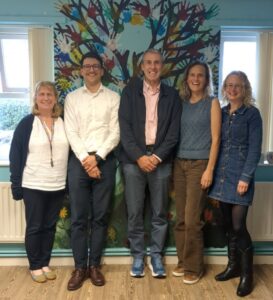
Five smiling people in front of a hand-painted tree image
Spring House CAT Team Sept 2025

We also stepped away from our usual Manchester venues for one of these. Simon Graham and CAT colleagues’ day on Integrating CAT for Complexity: a specialist NHS community service approach to working with people diagnosed with severe personality disorder and complex trauma in September 2025 took place in Liverpool at the team’s base. A snap here shows the team at the end of their well-received workshop.

2026 has seen a further three events delivered to date. Spaces are still available for the two-day introduction to CAT on 15/16 June. We’ll share details of more in the pipeline as soon as we can.

In the meantime, we’d like to check in with our local CAT community about your CPD needs. We’ve put together an online survey to ask about your interests and preferences. If you’d like to add your voice, we invite you to complete it (anonymously) by the end of May. The survey also asks about any obstacles to accessing CPD. If there are any events you yourself would like to consider offering through Catalyse. CPD Lead Jo Coggins will be pleased to hear your ideas and tell you more about practicalities and fees.

As a small organisation, we may not be able to meet all needs, and of course there are other providers of CAT CPD including regular offers from ICATA and ACAT. But your responses will help us consider and plan accordingly in our forthcoming CPD programme for the north.

Thanks in advance for sharing your thoughts, and we look forward to hearing from you by the end of May.

a green meadow with dappled sunshine and seeding dandelion heads

Spring 2026 Update

The sun shines on us again, the Easter break is behind us, and we’re looking ahead to the rest of 2026.  We wanted to share:

  • some news and updates on CPD
  • details of a CPD survey you can complete
  • the next Practitioner Course intake in May
  • where to find us on social media, and
  • a little ‘tech-ed’ on emails and newsletter updates

CPD News

Our first two CPD events of the year were well received. Participant feedback suggested they valued Sue Walsh and Kate Freshwater’s Thinking Organisationally: Developing CAT Supervision and Consultancy Skills in February, and Kim Dent-Brown’s 6-Part Story Method online event in March.  Both shared a common theme of metaphor and story. The Thinking Organisationally event additionally helped to introduce the approach that Sue and colleagues offer in the developing O-CAT strand of Catalyse work.

Another of David Harvey’s CAT as a Tool For Leadership online days took place on 23rd April.  We keep a rolling waiting list for repeats of his very popular day, and hope he may offer another later in the year.

Forthcoming CPD

Next up will be a two-day Introduction to Cognitive Analytic Therapy on 15/16 June. Founding course trainer Sarah Littlejohn is offering this in-person in Manchester. The workshop is ideal for those planning to apply for CAT Practitioner Training.  Additionally it gives participants a flavour of the teaching style plus how we utilise the first series of CAT Training Films as part of the Catalyse training.  Please share with anyone who may be interested.

On 19 June, David Harvey and Kate Freshwater lead a fully booked day in Manchester on CAT Reflective Practice: Skills for Facilitation. Do contact us if you’re interested in attending in a repeat.

We have several new events in the pipeline for later in the year, including a full day on Working with Challenging Scenarios in CAT on 14 September. This day will feature a selection of the second series of Training Films developed by Catalyse. Films Director Kathryn Pemberton will lead this day along with Rhona Brown. They will offer an opportunity for qualified CAT therapists, supervisors and trainers to work on their practice and skills in addressing threats to the therapeutic alliance through a variety of clinical challenges.  More details will be available soon.

2026 CPD Survey

A number of other CPD events for 2026 are in development, but we are also keen to hear from you, our local CAT community, about your CPD needs. We invite you to complete an anonymous survey by the end of May.

As a small organisation, we may not be able to meet all needs, but your responses will help us consider and plan accordingly in our forthcoming CPD programme.

As ever, if you’re interested in offering to run a day, please do contact CPD Lead Jo Coggins. She will be pleased to hear your ideas and tell you more about practicalities and fees.

CAT Practitioner Training 2026 – 2028

The application window for the 2026 to 2028 CAT Practitioner Training Course is open. The deadline for applications is 30 May 2026.  

Full details for both the standard and NHSE funded routes into training are available at 2026-2028 CAT Practitioner Training. There is some additional information this year on entry for those who have completed an ACAT-accredited Foundation Course year

We look forward to receiving and reading all applications. Interviews take place on 26 June.

Supervisors’ availability

We remain hugely grateful to all of those who support the Practitioner Training by marking written and recorded work, providing supervision, facilitating seminar groups, and offering training therapies.  Please do keep us updated on your availability to supervise. This is a key factor in the matrix of arrangements which underpin the training. We always welcome hearing from CATs if you would like to contribute to the course in any way. For example you might want to consider contributing to the course as trainer, supervisor, seminar facilitator, marker or training therapist.

Catalyse on Social Media

After the changes from a more ‘accepting-to-accepted’ Twitter to a far more polarised and problematic X, we are no longer active there. For now we are keeping our X account live to preserve the ‘footprint’ of tweets and interactions of previous years.

We have a Bluesky account so if you are also there, please do follow us and connect. We have recently set up a Linked In account too, which seems to be a platform where a lot of CATs are present. Do feel free to connect with us there, as we find our feet with that platform.  Catalyse Exec/Trainer Team members on Facebook sometimes post news of events on the UK CAT Therapists group there.

We don’t currently have plans to branch out into any of the video/reel based social media platforms.  However if any CATs in our networks are interested in this area and would like to help us think about whether and how to grow a presence in social media, then do get in touch.

Subscribing to (and Opting Out of) Our Communications

We value the connections that have been established over the years with the CAT community both locally and further afield who are interested in Catalyse and the various services offered.  However we only want to ‘push where it moves’. If for any reason you no longer want to receive our update mailouts, you can easily unsubscribe. Do this through clicking on the ‘unsubscribe’ link at the foot of any of our Mailchimp mailouts.

The internet is improving around privacy controls, which is a good thing. Unfortunately, sometimes this can mean spam filters get triggered even when you do actually want to receive a communication.  This sometimes happens for example when we try to contact supervisors and trainees at NHS addresses, or through certain email providers such as Gmail. This can be mutually frustrating.  So to avoid our direct emails (ending @catalyse.uk.com) or Mailchimp mailouts being blocked, please help by taking the following steps.

Don’t

  • mark Catalyse emails as ‘spam’ or ‘junk’ if you don’t want us to contact you. Instead just drop us a quick line at info@catalyse.uk.com to say thanks but no thanks, and we’ll remove you.
  • ignore any Catalyse emails that you do want to see, that you find in your Junk folder. Instead, mark them as ‘not Junk’, and hopefully they won’t be sent there again.

Do

  • add any Catalyse email addresses from which you do want to receive emails, to your address book or contacts.
  • mark them as ‘not Spam’ or ‘not Junk’.
  • if you wish, also whitelist the address(es) through your email provider set-up. (E.g. in Gmail, you can set up a filter such as ‘Never send it to Spam’ by going to your Settings, then ‘Filters and blocked addresses’)
  • if you have ongoing problems receiving Catalyse communications in your NHS setting, you could also contact your IT department. Asking them to whitelist our emails may help.

N.B. we process your personal data in accordance with the Catalyse Privacy Policy and update this regularly if any changes are made.

We hope you do want to stay in touch through updates like these. For those signed up to our mailing list, we emailed a version of this bulletin at the end of April. In any case, we’ll share more details of news and forthcoming events here on the website, which you can always visit when you want to.

Excerpt of an image of a CAT diagram

New – Introduction to CAT – 15 & 16 June 2026

We’re pleased to offer another two day Introduction to Cognitive Analytic Therapy workshop. This runs on 15th and 16th June, in-person, in Manchester. Sarah Littlejohn will be facilitating these days, drawing on presentations, active learning exercises and video excerpts. The workshop is open to anyone interested in learning more about CAT. It may be of particular interest to anyone applying for this year’s CAT Practitioner Training who hasn’t yet completed an introduction to the model.

Find out more at An Introduction to Cognitive Analytic Therapy

rough storyboard drawings against a warm yellow background

Playful, Inquisitive and Creative CAT with the 6PSM

We recently caught up with Kim Dent-Brown to hear more about his forthcoming CPD event on the 6-Part Story Method on 27th March. NB To make it more broadly accessible, Kim’s workshop will now take place online. Running it this way will give participants an added opportunity to try it out ‘as if ‘ in remote therapy. Read on to learn more about Kim’s journey with the approach over the years.

Kim, tell us about how you initially found the 6-Part Story Method (6PSM)

Back in the late 1980s I was training as an Occupational Therapist and one of the key elements of that profession is the therapeutic use of ordinary, familiar human activity. I had a background in the theatre so I was interested in all the creative approaches to therapy. This might involve using art, music, drama, movement, working with everything from clay to stories. That was the first time I came across the method. It seemed to me that it was a very attractive and simple way of helping a client create a workable, rich metaphor for their everyday life.

After my OT training I trained as a Dramatherapist and that enabled me to work in more depth with the method. Clients and I could turn the story into an improvised drama that we could then enact, witness, comment on and re-write at will. I was working as a Dramatherapist in an NHS specialist team for personality disorder and we all used the 6PSM at times. Mary Dunn, our team leader, shared it with Glenys Parry when she (Mary) was training in CAT with Glenys. That’s how the 6PSM filtered into the CAT world.

How has the CAT world received the 6PSM?

The CAT North practitioner training invited me to run a day for trainees but I can’t exactly remember when! Probably the early 1990s. It must have gone well because I was asked back the next year. Since then it has been a consistent element of the training, given at the very end of the first year. Every CAT North/Catalyse cohort since then has received it, except for two years when I did my own practitioner training and moved from trainer to trainee! I’m proud to say that feedback about the day (shared with Sarah Littlejohn) suggests that trainees find it an enjoyable, interesting, creative and powerful experience.

Generations of CAT practitioners have now learned the method. The one-day training gives enough of a basis for anyone to start to incorporate it into practice. I know practitioners who bring client stories to supervision, and supervisors who use it too. My own supervisor in my training encouraged me to use the 6PSM in place of administering the Psychotherapy File in the first few sessions. I never looked back. 

The 6PSM doesn’t fit only with one modality. I’ve taught it to counsellors, arts therapists, social workers and other groups. But for CAT I think it opens opportunities to look at reciprocal roles, traps and snags, procedures and exits.  

How can it help the therapeutic process?

I haven’t delivered CAT as a practitioner for a long time now so I can only answer generally. But I think introducing it early on sets a playful, inquisitive tone for a therapy. The practitioner relies on the client to interpret the story, not the other way round. This sets the client up as an expert in their own field, to be collaborated with and not ‘done to’. The process itself is almost always surprisingly enjoyable, which of course is reassuring. It may be surprising for a client who expects therapy to be like a visit to the dentist. 

If done before the reformulation letter (my preferred time to do it) then it can be a very useful source of material to help the practitioner look for process rather than content. It provides a treasure store of metaphor and simile that the therapist can use in the letter itself. Later in the therapy it can be a useful intervention to use if things have become stuck or circular. Then at the end it can be a handy way of reviewing the therapy itself prior to the goodbye letter.

Do you ever use this technique in other areas of your life/work?

My daughters are now in their thirties but when they were toddlers I used this to tell them bedtime stories. That’s to say I would ask then to identify the six elements of the story. Then I’d simply assemble them in order and elaborate a story for them. After a year or two they got wise to me but it was delightful to play storymaking with them this way. And in idle moments when I consider my retirement career as the author of a novel, I imagine using the 6PSM as a way of structuring scenes, chapters and the book itself. Then good sense takes hold and I cut the grass or plant some seedlings!

What will people take away from your day?

If you come on the course you can expect to learn how to facilitate somebody creating, telling and exploring their own new, fictional story. You’ll also take the opposite role, creating a story which might shine some creative light on an aspect of yourself or your life at the moment. Out of this practice, you’ll have the basic knowledge and skills to incorporate the 6PSM into your own work – perhaps after some further rehearsals and trials. If you are supervisor, the day will help you know the background to 6-part stories that your supervisees might bring.

Above all, I expect everyone will find this very experiential day an enjoyable and creative one. I think you may be surprised by how a method that is uncomplicated and light hearted can nevertheless be powerful and revealing.

To see more details or book a place on Kim’s day, go to The 6-Part Story Method page.